
Conceptual aerial rendering of a Thunderbird data center campus in the Enid corridor.
Four campuses — one, a site owned by the city, we’ve expressed interest in. A private power plant north of the city. A proposed municipally‑owned utility backbone — engineered to generate its own power and treat its own water, so it leans on Enid’s systems far less than its size suggests. Built to strengthen Vance Air Force Base, fund local schools, city and county services, and infrastructure for a generation, and set a new standard for how a project like this partners with the place it calls home.
Ask the Mayor and City Commission to approve the rezoning and give Project Thunderbird the chance to prove it can be done right. It takes about two minutes, and your signed letter is delivered to the Mayor and all six Commissioners.
On Monday, September 28, the Metropolitan Area Planning Commission recommended that the City Commission approve the Project Thunderbird rezoning request. The recommendation now goes to the City Commission, which will hold its public hearing at a Special Commission Meeting on Tuesday, October 27.
Thank you to everyone who attended and spoke, and to everyone who joined us at the open house on September 24. That includes those who raised concerns. The questions asked on the record will shape the work ahead, and if you have one we have not answered, send it to us.
Rescheduled. The rezoning items are no longer on the October 6 City Commission agenda. To allow for greater attendance and public comment, the City has moved them to a Special Commission Meeting on Tuesday, October 27 at 5 p.m. in the Grand Ballroom at the Stride Bank Center. View the City’s meeting agendas →
The Enid City Commission will hold a public hearing on the Project Thunderbird rezoning request, with the Planning Commission’s recommendation of approval before it. The Mayor and Commissioners make the decision. The meeting is open to the public, and comment goes on the record. If you support the project, we would welcome your attendance and your comments.
Rezoning is one step, not the last one. No data center can be built without a separate Intensive Use Review under Ordinance No. 2026-17, with full studies and another round of public review. See every step →
Questions about how public comment works? We are glad to help.
Ask us →Enid is built different — and Thunderbird was engineered to prove it. Here is the whole project on one screen: what stays with Enid, and how every concern is answered.
Tens of millions a year at full buildout — hundreds of millions over 25 years — for Garfield County Schools including Enid Public Schools, plus city and county services: roads, maintenance, parks, and other quality-of-life needs.
Power is generated on site, behind the meter. The project pays for the grid capacity and upgrades it uses, so the cost never lands on existing Enid ratepayers.
Cooling recirculates raw Kaw Lake water in a closed loop, with makeup drawn from that same raw supply — never Enid’s treated drinking water. Not all of it comes back: about 562 million gallons a year at full build is consumed, mostly keeping the turbines efficient on the hottest days. Every 1,000 gallons consumed funds watershed and habitat restoration, audited and published yearly.
Transmission and water infrastructure that stays in place and keeps serving the community. Backup power and fiber to Vance. Funding for Autry, for every school district in the county, and for watershed restoration.
Hardened backup power and fiber designed into the corridor — helping Vance meet the federal energy-resilience standard for critical missions set for 2030, at no cost to taxpayers, and strengthening the long-term case for the air base and the roughly 2,500 jobs it supports.
Fees, buffers, and protections are written into the development agreement and recorded against the land — so every commitment transfers on any sale and binds any future owner.
Figures reflect the project as currently proposed and designed. Details are subject to public review and final approval by Enid and its partners.
The most common thing we hear is a version of “this is already a done deal.” It isn’t. Thunderbird is on the first step of five, and under Enid’s new ordinance rezoning by itself does not allow a data center to be built.
The city decides whether these parcels may be used for heavy industry. Public hearings at the Planning Commission, then a vote by the Mayor and Commissioners.
Setbacks, noise limits and neighbor commitments are put in a written agreement and filed at the county, so they stay with the property no matter who owns it.
Plainsmen Holdings and the Enid Regional Development Alliance will screen the major hyperscale operators in this market for the best corporate citizen we can attract. Whoever is chosen still has to clear Step 4 and be approved by the Mayor and Commissioners.
The real test. Full studies of water, power, traffic, noise, construction and cleanup. A public meeting, mailed notice to neighbors within 300 feet, and a public comment period. The Planning Commission recommends; the Mayor and Commissioners approve or deny. Only then is the Intensive Use Agreement signed.
Not one permit may be issued and not one shovel may break ground until every step above is finished.
Every year the operator must report its water, wastewater and energy use, its emissions and testing, its employment and community investment, and every complaint it received — to the City Manager. The City keeps the right to publish that information, and a public complaint form has to stay online the whole time.
City of Enid Ordinance No. 2026-17, adopted August 18, 2026 (Enid Municipal Code Title 11, Chapter 8, Article C). A data center requires Intensive Use Review and approval by the Mayor and Board of Commissioners; rezoning alone does not permit one. Steps 2 and 3 are commitments by the applicant, not requirements of the ordinance. No operator has been selected. Project as currently proposed and subject to final approval by the City of Enid.
How to be heard. The Planning Commission and City Council meetings are public, and comment goes on the record. Property owners within 300 feet get mailed notice. If you want to speak and are not sure how, ask us and we will point you to the right meeting.
Ask how →New to all of this? Start here. No jargon — just what this project is, and why the parts that sound scary aren’t so scary once you see how they actually work.
What is a data center, really?
It’s a building full of computers. Picture a library — but instead of books, it holds the computers that run things you already use every day: your bank app, your doctor’s records, streaming, and the “cloud” where your photos live. Those computers run day and night, so the building needs steady power and a way to stay cool. That’s really all it is.
Is it safe to live near?
Yes. Nothing dangerous is made or stored here — it’s not a refinery or a chemical plant. The two things a neighbor might notice are a low hum and some lights, and both are capped on purpose: no louder than a normal conversation at the property line, and lights shielded and aimed down so they don’t shine into your yard or wash out the night sky.
Will it use my electricity or raise my bill?
No. The project makes its own electricity, right on its own property, from its own power plant — like a house running on its own generator. It doesn’t plug into the same power that runs your home, so it can’t take electricity away from you and it can’t push your bill up. If it ever needs the regular grid, it pays 100% of that cost — not you.
Will it use up our water?
It cools its computers with raw, untreated water from the Kaw Lake pipeline — not the clean drinking water from your tap. It uses that same water over and over in a closed loop, like the coolant in a car radiator, instead of running it through cooling towers that boil it off. At full build it is modeled to need about 562 million gallons a year — real water, and less than most of the big data centers being built in Oklahoma. Some of it is used up: on the hottest days water is evaporated to keep the turbines efficient, and that is what drives the number up on a hot day. It is counted in the total. Every 1,000 gallons it uses pays into a fund that repairs and protects water here first.
Want the details behind any of this? Keep reading — the rest of this page shows exactly how each of these promises is engineered, funded, and made binding. Still have a question we didn’t answer simply enough? Tell us — we’ll explain it in plain terms.
People keep asking us exactly where each campus sits, so here it is by street: North on Phillips Avenue between 42nd and 54th; East at 66th Street and East Willow Road; West along Rupe Street between 16th and 30th; and South along 30th Street from Southgate Avenue down to 80 acres below Fox Drive. Three of the four campus sites are in hand. The fourth — the East campus — is the 66th Street Industrial Park, land Enid owns and has designated for economic development. We’ve expressed our interest in acquiring it from Enid and hope to work toward an agreement. We’ve drawn it into the map so you can see the full vision.
Four campuses on a shared backbone: the proposed Patriot Utility District’s 345 kV ring, a central water and fiber line anchored to the Kaw Lake Pipeline, and a hardened power extension to Vance AFB. Each campus takes 138 kV on site. Schematic — positions are relative, not to scale.
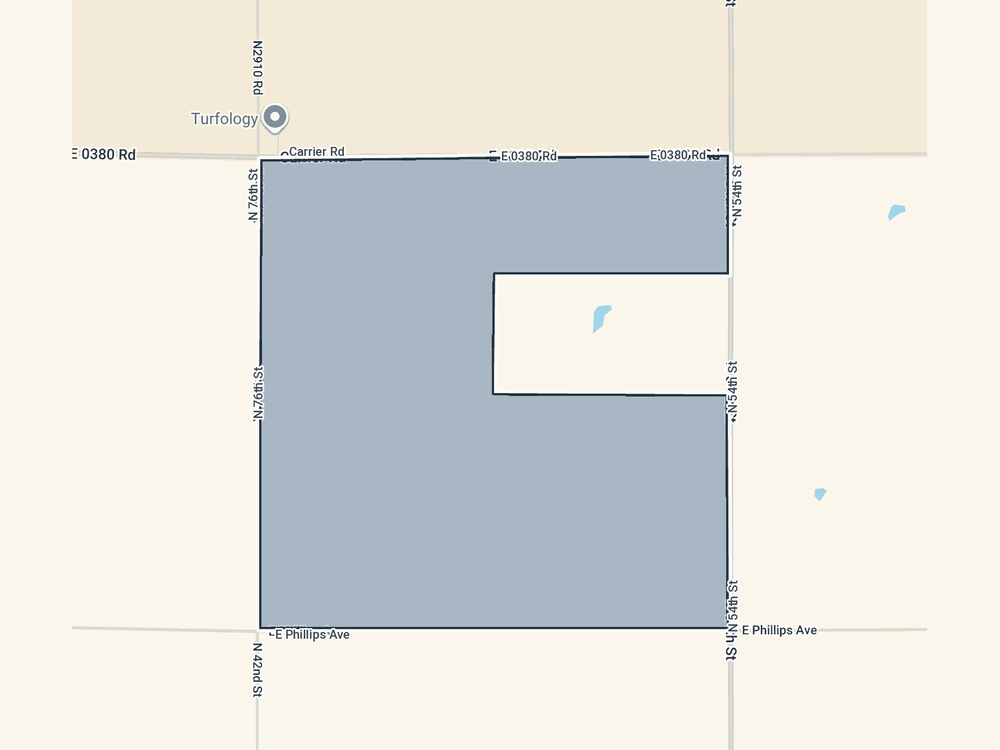
Proposed campus
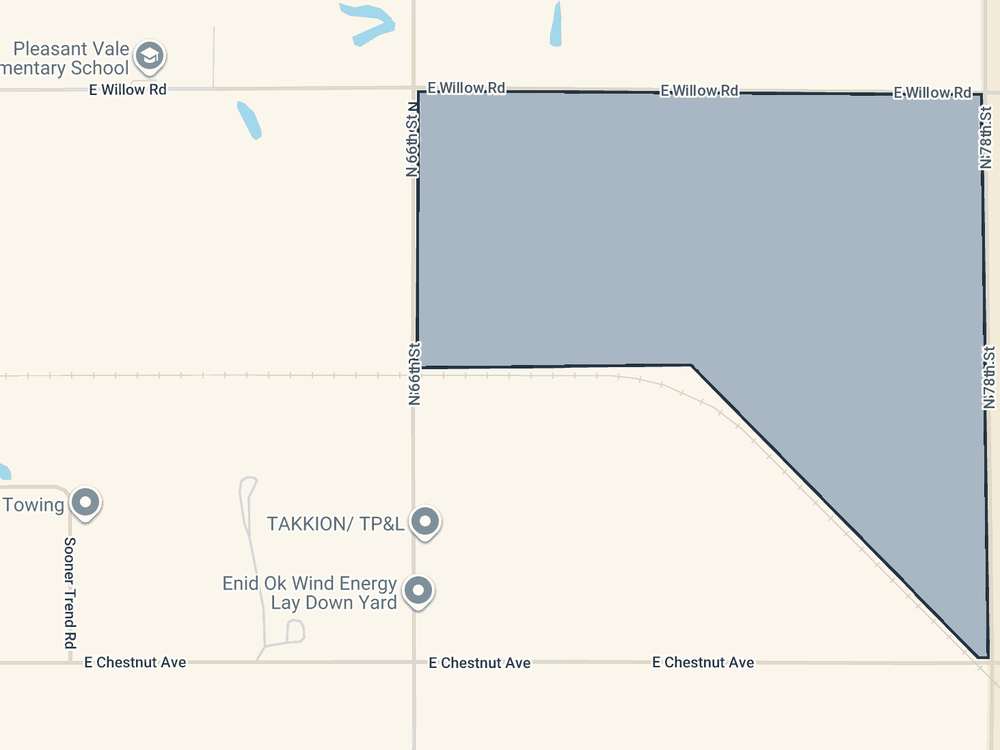
Proposed campus
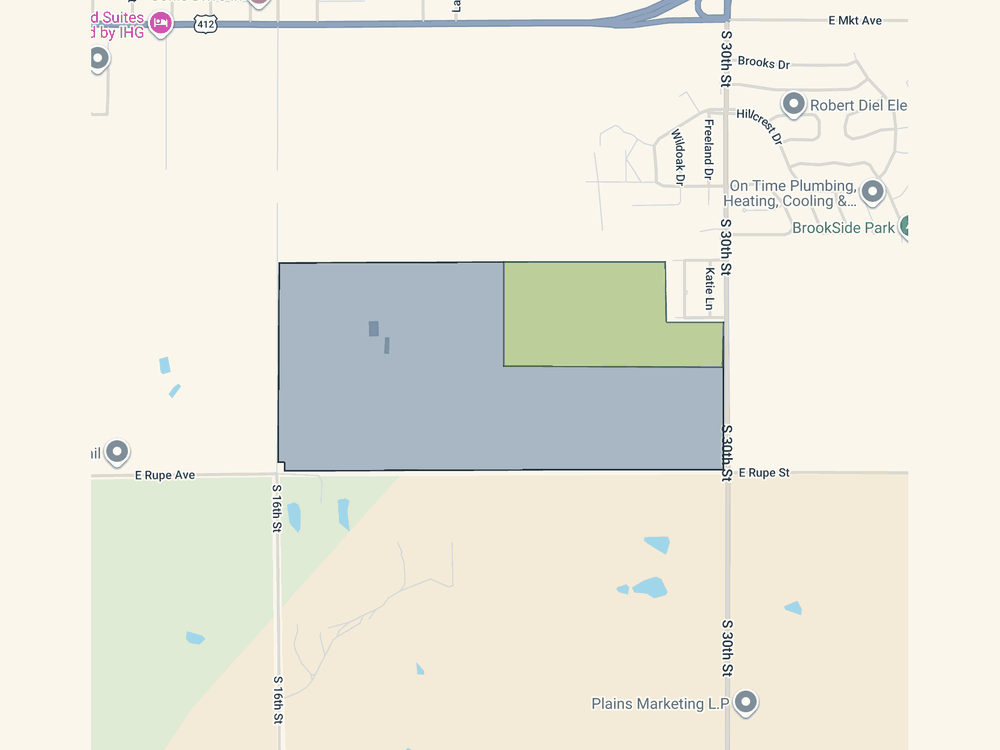
Proposed campusHeld as agricultural
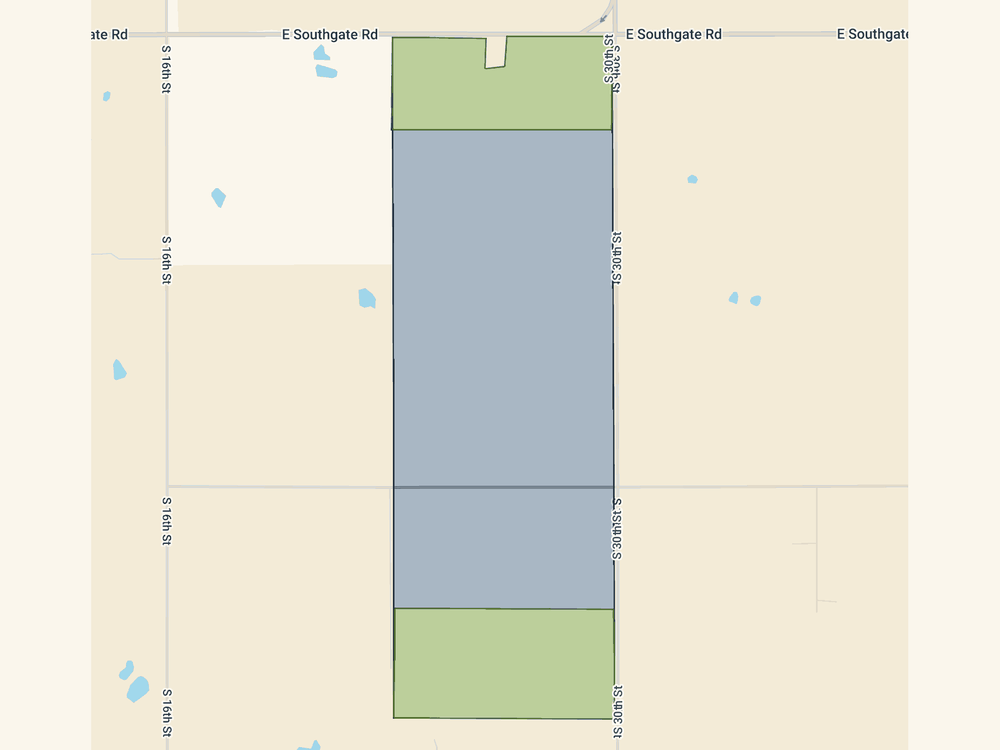
Proposed campusHeld as agricultural
Data centers are buildings filled with computers that run around the clock — they power AI, national security, cloud services, banking, streaming services, medical systems, and an increasing share of the digital infrastructure people use every day. Demand for these facilities is accelerating, and communities across America are having this exact conversation right now. Enid is one of them. Project Thunderbird is our attempt to do it right — to set a new standard for how a data center project partners with its host community.
A natural gas power plant north of the city, to be built and paid for privately — not by taxpayers. Thunderbird is designed to generate its own electricity behind the meter, so that it would not compete with Enid homes and businesses for grid power. Any grid capacity or upgrades the project uses would be paid for by the operator, not Enid’s ratepayers — under Oklahoma’s ratepayer-protection law for grid-served load, and under the agreements the City will require for the rest. That is how it avoids the shortages, outages, or rate increases that grid‑connected data centers can create.
Raw Kaw Lake water for cooling and power, never Enid’s treated drinking water. No conventional open-loop evaporative cooling towers. About 562 million gallons a year at full build, published in full. Every 1,000 gallons consumed will carry a surcharge funding watershed and habitat restoration — independently verified and publicly reported every year.
Designed to provide hardened backup power and fiber to Vance Air Force Base — helping the base meet the federal energy-resilience standard for critical missions set for 2030. As AI compute becomes critical national infrastructure, the corridor will position Enid to play a strategic role in the future of defense — strengthening the case for Vance and the families it supports.
New public revenue at a scale that could put Garfield County Schools, including Enid Public Schools, among the better-funded in Oklahoma — and strengthen city and county services and infrastructure alongside them. Over the life of the project, that funding is projected in the hundreds of millions of dollars.
Up to 600 permanent, high-paying technical roles once the corridor is running — plant operators, electricians, network and security techs, and skilled trades — plus roughly 4,000 prevailing-wage construction jobs over the 5–7 year build. Local hiring preference will be written into the land’s entitlements.
Secure, sovereign compute on American soil is fast becoming front-line infrastructure for national defense and intelligence. By hosting it at home, Enid will step onto that map — a resilient, hardened platform that strengthens Vance AFB and positions our community at the leading edge of the next generation of national security.
Most Oklahoma towns wrestling with whether a data center is right for them are caught in a trap: missing even one key infrastructure component can come at a significant cost to residents. Enid is the rare exception. All four pillars below already exist within the same few miles, and within reach of all four campus sites. Here is what sets Enid apart, pillar by pillar:
Oklahoma State University Extension published the questions a town should put to any data center proposal. We answered all sixteen topics, in OSU’s order, and marked each answer as a City requirement, a current proposal, a proposed commitment or details pending, with its source. Where an answer belongs to the Intensive Use phase, we say so instead of guessing.
85 answers · searchable · every claim sourced to the ordinance, state law or our own planning materials · updated 15 October 2026. OSU fact sheet BAE-1772 is the question list; OSU has not endorsed the project or the answers.
We have heard a wide range of questions from Enid residents, public officials, and reporters. The most common ones are answered below.
Here is the arithmetic, so you can check it. At full buildout the corridor is up to 2,750 MW of IT capacity plus up to 3,300 MW of on-site generation. Applying the leanest staffing ratios in the Hamm Institute for American Energy and University of Southern California workforce analyses:
| Data halls across the corridor2,750 MW × 0.18 jobs per MW | 495 |
| On-site power plant at North3,300 MW × 0.02 jobs per MW | 66 |
| Most-automated direct-jobs case | 561 |
| What we publish | Up to 600 |
The math lands at about 561 and we publish “up to 600” — rounded up to the nearest hundred. It is the ceiling on this lean case, not on the range. Those ratios are the low band of the two studies; staffed at their mid-range the same corridor would employ considerably more, and so would a less automated operator. We would rather show you the low end and be wrong in your favor.
The positions themselves are plant and data center operators, electricians and instrumentation technicians, network and security technicians, systems administrators and engineers, mechanics and skilled trades, plus the managers, administrative and facilities staff any operation this size needs — every one of them listed by federal job code in Where the money goes, with local hiring preference written into the land’s entitlements and Autry Technology Center as the named training partner. Construction will employ roughly 4,000 workers at prevailing wage over a 5–7 year build-out. Both workforce analyses are linked in full under Sources & Methods at the bottom of this page.
That said, it is not the same scale as a manufacturing plant, and we are not pitching it that way. The lasting community benefit lives in the tax revenue, the Kaw Lake debt paydown, the public infrastructure, and the hardened backbone for Vance — not in the headcount alone. We think Enid deserves a clear picture of both sides.

Water is the question we hear most. Here is the whole answer, in plain numbers.
These are estimates from our engineering work so far, for everything at full build — all four campuses plus the power plant. They are not a permit limit, and the detailed calculations are not finished yet.
It comes from Kaw Lake, as raw water. Raw means untreated. It never goes through the plant that cleans Enid’s drinking water. It is not the water in your tap.
We plan to take 2 million gallons a day. Over a year that is about 730 million gallons — more than the 562 million we expect to use. So there is room to spare.
On the hottest day, the project could need 7.3 million gallons. We would still only take 2 million from the lake. The other 5.3 million comes out of tanks at the North campus that hold about 31.8 million gallons.
That is enough for about six hot days in a row. How big those tanks should be, and how fast they refill, is part of the engineering we are still finishing.
Enid’s new water supply comes from Kaw Lake. Here is how full the lake has been through the last two droughts, today, and after the June floods.
The campuses cool their computers with liquid that keeps circling back around, like the coolant in a car. There are no open cooling towers — the thing that uses the most water at a normal data center.
Most power plants dump their waste heat into water. Ours uses air-cooled equipment instead. Most of the water inside the plant stays in its loop and gets used again.
On the hottest days we mist a little water into the air going into the turbines. Cooler air keeps the plant running strong. That water evaporates and does not come back. It is the main reason a hot day needs 7.3 million gallons, and it is already counted in every number above.
Water that has done its job does not disappear. It goes into Enid’s sewer system, and the city cleans it at the wastewater plant.
What comes out is gray water — clean enough for industry, not for drinking. Enid already sells gray water to the Koch fertilizer plant, which uses it instead of fresh water. That program offsets more than 4 million gallons of fresh water a day there today.
Koch reuse figure: Black & Veatch, which designed the system that takes tertiary treated wastewater from Enid’s plant to the fertilizer facility.
More water going into the city’s system means more gray water the city can sell. So the same water gets used twice, and Enid gets paid both times.
We will write into our agreement with the City of Enid a fee on every 1,000 gallons we use. That money pays for repairing watersheds and wildlife habitat — in Enid first, then across the wider region.
An outside auditor will check the results every year, and every report will be published for anyone to read.
The power plant will be built and run to meet or beat every air-quality standard that applies — Oklahoma DEQ, the U.S. EPA, and local, state and federal rules.
Enid also has a head start here. Industry has been capturing CO₂ from Enid for decades and sending it out on a 120-mile pipeline. The power plant’s CO₂ could use that same kind of infrastructure to reach storage sites already in operation.
If you live near a campus, this is probably the thing you actually want to know, and it deserves evidence rather than reassurance. So we went and looked at two places that already have what Enid is being asked to consider — using the federal government’s house price index, not anybody’s opinion.
Google opened its Pryor campus in 2011. Change in home values, 2011–2025.
What it shows: homes in the ZIP code with the data center gained more than the counties around it and more than the state. Fifteen years is long enough to see a trend rather than a blip.
Meta assembled its site in 2019, announced in 2022 and came online in 2025. Change in home values, 2019–2025.
What it shows: three percentage points across six years is close to no difference at all — and that is the finding worth having. Living next to a data center did not cost these homeowners anything.
Nothing has been built here, so there is nothing yet to attribute to it — anyone who tells you otherwise is guessing. For reference only: the census tracts around the four proposed campuses gained 28–45% over the same six years as the Kansas City window, and 54–61% over the same fifteen as Pryor. That is Enid’s own market, before any of this.
Federal Housing Finance Agency House Price Index, all transactions. No ZIP or tract index is published for the area immediately around the Meta campus, so Kansas City is shown at county scale. Enid figures are the census-tract indexes covering homes within one mile of each campus boundary, weighted by housing units; North, East and South share the same rural tract, and one tract holding part of West publishes no index. Neither case study is a promise about Enid — different markets move differently. Campuses as currently proposed and subject to public review and final approval by the City of Enid.
If your home is near one of the campuses, we would rather talk to you directly.
Talk to us →What’s binding →The protections aren't only legal — they're engineered into how the corridor is physically built. Here is how the site design itself responds to the most common concerns we have heard. These illustrations are conceptual and reflect design intent; final engineering will be confirmed with our IPP partner, the developer, ERDA, and the City of Enid.
Noise, traffic or lights you want to raise before this is decided?
Tell us →Public hearing, Oct 27 →
Thunderbird isn’t just making promises — it has designed and proposed a legal and financial architecture built to give Enid permanent control over this project’s impact.
The proposal is for a municipally-owned public utility — the Patriot Utility District, developed in partnership with ERDA and community leaders — to own the power backbone, the water delivery lines, and the dark fiber that tie the corridor together. It would be funded entirely by concession fees paid by the data center — not by taxpayers, and with nothing passed through to Enid’s existing water or electric customers. As long as the wires carry power, the pipes carry water, and the fiber carries data to the data center, the power plant, and Vance, that revenue stays in Enid. If the data center ever changes hands, the infrastructure stays, the concession fees stay, and the revenue stays — every term recorded against the land so it binds any future owner. The details are still being worked out, in the open.
Every financial commitment will be embedded in the land's zoning entitlements. Concession fee payments, the infrastructure, water supply commitments, community betterment contributions, and building restrictions will all run with the land and transfer with any sale. The community will get durable commitments; future operators will get the regulatory certainty they need to invest.
Change is hard, especially when it’s close to home. In most data center projects, nearby homeowners are left to deal with the consequences. We want to flip that. Whether you choose to stay or relocate elsewhere in Enid, we want to support you.
This program will be run by ERDA — Enid’s own economic development nonprofit — not by the developer. An independent appraiser sets your home’s value based on what it was worth before the project was announced. Every eligible homeowner has three full years from the time construction ends near their home to decide whether to accept an above market offer to purchase their home. In the meantime, you can stay and take $15,000 for home improvements — and if you later choose to sell, that $15,000 is simply deducted from your final amount. You decide what’s right for your family. Nobody is forced to do anything.
Property line to property line. We measure from the Project Thunderbird campus property line nearest to you, to your property line. Not from a data center building, and not to your house.
Example: on a large lot, your house may sit 900 feet back — but if your property line is 200 feet from the nearest campus property line, you’re in the 0–300 ft group (150%). It’s the distance between property lines that counts. This program is separate from the 500-foot building setback, which is measured from the data center buildings themselves. Not sure where you fall? Ask us and we and ERDA will confirm it for your address.rsquo;ll help you check your address.
If your home appraises at $200,000, you’d be offered $300,000 — that’s 150% of its value. If it appraises at $275,000, you’d get $412,500.
The appraisal is based on what your home was worth before anyone heard about the project — so construction activity can never reduce your offer. We’ll also cover your closing costs and up to $5,000 in moving expenses. You have three full years to decide.
If your home appraises at $200,000, you’d be offered $250,000 — that’s 125% of its value. If it appraises at $275,000, you’d get $343,750. Same protections: pre-announcement appraisal, three-year window, closing costs covered.
Completely voluntary. No one knocks on your door and tells you to leave. You get a written offer, and you decide on your own timeline.
You don’t have to choose right away. Stay in your home and take a $15,000 improvement grant — new windows, privacy fencing, mature trees, acoustic insulation, landscaping. Your home, your choice.
Decide within the three-year window that you’d rather sell? You can — the $15,000 is simply deducted from your final sale amount. Just submit your receipts to ERDA.
No Enid homeowner within the impact zone will be made worse off. That’s not a slogan. It’s designed as a funded, binding commitment, independently administered by people you know and trust.
Every standard in Enid’s intensive-use ordinance — met or exceeded.
Campus buildings set no less than 500 feet from homes — at every campus.
Construction traffic will stay on US–412 routes — off downtown and residential streets.
The zoning ordinance limit at your property line — about a normal conversation by day, quieter at night.
Designed to fit Enid’s character, not anonymous boxes.
Buffer zones, mature trees, screening walls.
Written into the entitlements, not left to goodwill.
A funded, bonded plan to remove equipment and restore the land at end of life.
Full-cutoff, shielded fixtures aimed down — protecting neighbors and Vance’s night training.
Quieter, cleaner natural-gas backup once the data centers are operational — no diesel fleet, no fuel trucking, no diesel exhaust. Any temporary construction use will be settled in the Intensive Use Agreement before permits.
On-site detention and managed runoff so neighboring land and drainage aren’t overburdened.
Everyone in Enid understands what Vance means. It’s not just 2,500 jobs. It’s the families who met at the base, the kids who grew up on base housing, the businesses that exist because Vance exists.
The Patriot Utility District is designed to do more than power data centers. It is being structured to provide hardened, secure backup power and fiber directly to Vance Air Force Base — helping the air base meet the standard Congress set for military installations in 10 U.S.C. § 2920 — 99.9% energy availability for critical missions by the end of fiscal year 2030, with installed sources preferred over emergency generators — at no cost to the federal government.
It could also position Enid for what comes next. The Department of Defense increasingly treats AI compute, sovereign data, and energy resilience as strategic assets — and many analysts believe that data centers will become the next generation of critical national infrastructure, as essential to defense as shipyards and air bases were in earlier eras. A corridor designed for hyperscale compute, hardened power, and a 24/7 USAF training mission gives Enid a credible role in that future.
An air base with the option to connect to private power and fiber infrastructure of this scale — with capacity to support workloads relevant to national defense — would have a stronger long-term case to keep and expand, without costing the Department of Defense a dollar. That matters to the 2,571 people who work at Vance — active duty, reserve and government civilian — the families behind them, and a community of 50,000+ Enid residents.
Infrastructure that serves a federal military installation can carry legal protections that commercial-only projects do not. Future moratoriums, taxes, and regulatory changes would face this argument.
A designed defense connection would open a pathway toward FedRAMP and Department of Defense certification — giving a future operator a credible route into federal cloud and sovereign AI workloads, an advantage few competing sites can offer.
Few data center projects in America have been designed from the ground up around the resilience of a nearby military installation. In Enid, the corridor and the Air Force base are designed to reinforce each other — and that gives Vance, and the families and city that depend on it, a stronger long-term footing.
Plainsmen Holdings' founders are people who grew up here. We went to Enid schools and graduated as Enid High Plainsmen. We are not an out-of-state developer and we don't answer to a fund in New York.

Co-Managing Member
Jason was raised in Enid, where his family’s business, Metals USA, has been rooted in the community for over a century — and where he learned grit, hard work, and an obligation to community. A proud Enid High graduate and Fulbright Scholar, he founded two KIPP public charter schools, then built and led Curriculet, a venture‑backed education company seeded by Netflix co‑founder Reed Hastings and acquired in 2016. He was recognized nationally with the Jefferson Award for Public Service. Jason assembled Project Thunderbird to bring lasting opportunity back to the hometown that shaped him.

Co-Managing Member
Chad is co‑owner and Executive Chairman of Dillingham Insurance, a fourth‑generation, Enid‑headquartered firm in its 99th year that ranks among the top 1% of independent insurance agencies nationwide. A conservationist and civic leader, he was appointed by Governor Kevin Stitt as a Commissioner of the Oklahoma Department of Wildlife Conservation, serves on the Oklahoma Hall of Fame Board of Trustees, and helped lead the campaigns that passed more than $190 million in bond issues for Enid Public Schools. He and his brother Jed run a 2,000‑acre cattle ranch in northwest Oklahoma, and he and his wife Lisa of 33 years are proud to call Enid home.

Member
Aaron grew up in Enid where, like his brother, he learned the impact of hard work and investing in community from working in the family business, now Metals USA. A proud Enid High graduate, he became a serial technology entrepreneur in San Francisco, founding and growing several companies since 1992. He currently owns and operates a historic aviation business in the San Francisco Bay area, where he is also leading a major real‑estate redevelopment of the historic bayside property. Enid will always be home, and Aaron looks forward to creating lasting opportunities for the hometown where he first earned his pilot’s wings.

Member
Troy was raised in Enid, where he learned the values of hard work, integrity, and treating people right from an early age. Working side by side with his father, Les Phillips, at Enid Mack Sales, he built a successful business career and lifelong relationships with customers, employees, and the community. After helping grow the family business and ultimately selling it in 2016, Troy has remained committed to giving back, supporting economic growth, and creating opportunities that help Oklahoma communities thrive for generations to come.
Our families have built businesses in our city for over a century — in steel, insurance, energy services, and transportation. Enid isn't a pin on a map for us. It's where we grew up and where our roots run deepest.
When we realized that Enid sits on perhaps the finest infrastructure in the world for large-scale data center development — the natural gas, the access to an abundant replenishing water resource, the transmission, the geology, the land — we sought partnership with community leaders and ERDA. Because from the very beginning, this had to be done the Enid way.
We are working alongside community leaders and ERDA to bring a data center partner to Enid whose values align with this community. The companies we are in conversation with will be evaluated on a clear standard: will they be a strong long-term partner for our city? And we will not pretend every piece is finished — the East campus (Enid’s 66th Street Industrial Park, land designated for economic development) is a site we’ve expressed interest in, and the Patriot Utility District that would tie the corridor together is still taking shape with ERDA and community leaders. We think Enid deserves to see the whole plan honestly, and to help shape it.
Our history with Enid goes almost as far back as Enid itself. Our families built businesses in this community that are over 100 years old. Now, we are hoping to partner with community leaders, ERDA and Vance Air Force Base to secure Enid's economic future for future generations to come.
We live here. If you want to ask us something directly, we will answer.
Reach us →Public hearing, Oct 27 →Strip away the engineering and a project like this comes down to one question: what does the community get, and can it count on it? Here is where the value will go. As proposed, every item below will be funded by the project itself — and built to last.
Concession fees and project revenue — paid by the data center and its tenants, not by Enid taxpayers — flow into commitments that stay with the community.
Tens of millions a year at full buildout — hundreds of millions over 25 years — for Garfield County Schools including Enid Public Schools, and for city and county services: roads, maintenance, parks, and other quality-of-life needs.
As the Kaw Lake Pipeline’s first anchor customer, Thunderbird will help repay the $330 million in municipal debt Enid is already carrying.
A surcharge on every 1,000 gallons consumed will fund watershed and habitat restoration — in Enid first, then across the region — independently audited and published every year.
Backup power and fiber designed into the corridor for Vance — strengthening the long-term case for the base and the roughly 2,500 jobs it supports.
Up to 600 permanent jobs at full buildout, plus thousands of construction jobs during the build — lean relative to the industrial investment it represents. Thunderbird funds Enid at industrial scale without hiring at industrial scale: a customer for local businesses, not a taker of their talent.
Sustained funding for Autry Technology Center to train a world-class workforce here at home — not for one project, but for generations of Enid students and the employers who hire them.
Every commitment above will be embedded in the zoning entitlements through a Special Planned Unit Development, so it runs with the land and survives any change of ownership. Figures reflect the project as currently proposed.
People ask what these jobs would be, how many of each, and what they would pay. Here is the whole list, by federal job code, with the Oklahoma average wage for each one.
| Job | Staff | Pay (OK) |
|---|---|---|
| 15-1241Computer & systems administrators | 80–140 | $95,000 |
| 15-1251Software developers & engineers | 40–80 | $112,000 |
| 49-9021Data center operators (technicians) | 120–220 | $62,000 |
| 49-9041Industrial machinery mechanics | 40–70 | $64,000 |
| 49-2094Electrical & electronic equipment techs | 30–60 | $68,000 |
| 17-2081Environmental engineers & specialists | 10–25 | $87,000 |
| 43-6014Logisticians & supply chain specialists | 15–30 | $76,000 |
| 37-2011Janitorial & facilities maintenance | 30–60 | $42,000 |
| 11-1021General & operations managers | 20–40 | $118,000 |
| 43-9199Administrative & support | 50–100 | $52,000 |
| Subtotal | 435–825 |
| Job | Staff | Pay (OK) |
|---|---|---|
| 51-8011Power plant operators | 25–40 | $102,000 |
| 49-9041Industrial machinery mechanics | 20–35 | $64,000 |
| 49-2094Electrical & electronic equipment techs | 15–30 | $68,000 |
| 47-2111Electricians | 10–25 | $62,000 |
| 51-4041Power distributors & dispatchers | 10–20 | $87,000 |
| 17-2081Environmental engineers & specialists | 5–15 | $87,000 |
| 49-9071Maintenance & repair workers | 15–30 | $56,000 |
| 13-1081Health, safety & environmental managers | 5–10 | $96,000 |
| 43-6014Logisticians & supply chain specialists | 5–15 | $76,000 |
| 43-9199Administrative & support | 10–25 | $52,000 |
| Subtotal | 120–245 |
About 1.4 times the pay of the average manufacturing job in Oklahoma. Every wage above is the Oklahoma average for that job code, and the $74,000 is those wages weighted by the staffing numbers in the table — so you can check it yourself.
Sources. Staffing ranges are derived from the Data Center Employment Forecast Analysis and the Combined Cycle Gas Turbine Plants Employment Forecast Analysis, both published by the Hamm Institute for American Energy with the Zage Business of Energy Initiative at the University of Southern California. The $52,000 Oklahoma manufacturing comparison is from the Oklahoma Employment Security Commission and IMPLAN (2024). Wages are Oklahoma occupational averages for each federal SOC code. Job counts and the split between roles are our own estimate built on those analyses — see Sources & Methods.
So how many people is that? Add up the low ends and you get about 555. Add up the high ends and you get about 1,070. We plan around the low end — roughly 560 — because it assumes the most automated operation we think is realistic. A less automated operator would hire more. We got there a second way in the jobs question in the FAQ — megawatts times published staffing ratios rather than job code by job code — and that lands at 561. Two different methods, six jobs apart. That is why we publish the conservative number instead of the biggest one we could. Construction is separate again: roughly 4,000 workers at prevailing wage over a five-to-seven year build.
Think this money should go somewhere else first? That decision belongs to Enid, not to us.
Tell us where →Public hearing, Oct 27 →Big projects get talked about in big numbers. Most of us don’t live in big numbers. We live on our street, at our kid’s school, at the ballpark on a Saturday. So take a drive across town this week and look at it twice. Once for what it is. Once for what it could be.
Enid has never been short on ideas. There’s a master plan for a multi-sport complex. A trails map with 33 corridors drawn on it. A street plan covering all six wards. A pipeline to Kaw Lake already in the ground. And our crews, teachers, officers and firefighters stretch every dollar they get.
The plans are drawn. The people are already here. Thunderbird doesn’t build any of it. It pays into the pot — the city, the county, and the schools — and then Enid decides. So the question belongs to you: what would you finish first?
Enid has a master plan for a multi-sport complex out at Garland and Rupe. Ball fields built for tournament weekends. What if we finished it, and became the host city people love?
Enid Public Schools and the county’s rural districts are full of people who are good at this. What if we could keep every one of them, and give them the supplies they need?
The city has a road plan that covers all six wards. It gets worked a few blocks at a time, because that’s what the budget buys. What if it all got done at once?
Enid’s trails plan maps 33 corridors across town. A handful are built, and people love them. What if the rest got connected and you could walk or ride safely throughout town?
Our officers and firefighters cover a whole city and a lot of county road besides. What if there were more of them, in newer trucks, with the gear they’d pick themselves?
The square. David Allen Memorial Ballpark. Stride Bank Center. A new park and amphitheater going in on Garriott. What if every storefront around them was full?
Enid has the hospitals. What’s thin is the bench. Specialists pick towns with good schools, good parks and momentum — which makes everything else on this page a recruiting tool.
Our kids don’t leave because they can’t learn a trade here. They leave because the work is somewhere else. What if Autry were training plant operators and electricians for jobs twenty minutes from home?
Downtown Enid is a state-certified arts district, and Gaslight Theatre has been packing people in for years. What we lost was the screen — the eight-plex at Oakwood closed, so a movie night means a drive. What if there were arts and programming all year, and a theater worth staying in town for?
We built this list from conversations around town. If we missed the thing you’d put at the top, tell us. We read every message, and what people ask for shapes what we put in writing.
Tell Us What Enid NeedsThis page describes the project as proposed. It is subject to public review and final approval by the City of Enid.

Four campuses — one, the East campus, a site we’ve expressed interest in — will be built in stages at all locations over roughly a five‑ to seven‑year period, not all at once. The exact order and pace of each campus will follow normal construction timelines and conditions for a project of this type and size, and could shift once a hyperscaler is chosen. The diagrams below are sample timelines for illustration only.
First IT capacity will come online across all four campuses early, with each site then building out in stages toward full size. The exact order and pace shown here are illustrative and will depend on the hyperscaler once one is chosen.
A small first stage will light up IT across all four campuses. The North campus power plant and much of the IT capacity will then be built, with the remainder — plus West, East, and South — following over the full horizon.
Illustrative only — no firm capacity figures implied. The actual staged build‑out may proceed differently.
The right question isn't "Are data centers good or bad for Enid?" Data centers are tools — their impact depends entirely on how they're structured. The real question is: under what conditions would a project actually benefit our city without damaging the community long-term? Here is how Thunderbird is designed, concern by concern, to answer that question.
When data centers plug into the local grid, communities can end up competing for the same power supply. In some markets, rapid growth in demand has contributed to rate pressure on residents and businesses.
Thunderbird will make all of its own electricity on-site, behind the meter, from a private natural-gas plant north of the city. It is designed so it doesn’t lean on the grid that serves Enid homes and businesses — and if grid power is ever needed, 100% of that cost will be passed on to the hyperscaler, not Enid’s ratepayers. That is how it avoids the shortages, outages, or rate increases that grid‑connected data centers can create.
Evaporative cooling is common in the industry, and water consumption can become a concern — particularly in regions where supply is limited or where residents worry about long-term availability.
Thunderbird will not use potable water to cool its computers or run its power plant — both draw raw Kaw Lake water, upstream of Enid’s drinking-water plant. The only city water it will use is for ordinary building needs like restrooms and drinking fountains. At full build the project is modeled to need about 562 million gallons of raw water a year, an average of 1.54 MGD. As the Kaw Lake Pipeline's first anchor customer, it would help Enid carry the pipeline debt it is paying today, and every 1,000 gallons consumed will carry a Water Restoration Fund surcharge for watershed and habitat restoration — independently audited and published every year.
Homeowners near large-scale development can face construction disruption, noise, and visual impact. Without a clear mitigation plan, these concerns erode community trust and can stall projects entirely.
Measured from the nearest campus property line to the homeowner’s property line: owners of a primary residence within 300 feet will be offered the choice to sell at 150% of what their home was worth before anyone heard about the project. Those between 300 and 500 feet will be offered 125%. Anyone who chooses to stay will receive a $15,000 improvement grant. All administered by ERDA — a trusted local nonprofit — not the developer.
Large-scale projects often involve significant tax incentives. When those aren’t structured carefully, local schools, services, and infrastructure can absorb the impact without seeing proportional benefit.
We are proposing new public revenue at a scale that could put Garfield County Schools, including Enid Public Schools, among the better-funded in Oklahoma — with more to strengthen city and county services and infrastructure. Better-paid teachers. Better facilities. Over the life of the project, that funding is projected in the hundreds of millions of dollars.
Data centers can consume a community’s land, power, and water — and lean on public incentives — while the biggest returns flow to an outside company. Residents worry they’ll carry the costs and see little of the benefit.
As proposed, Thunderbird will generate and/or underwrite 100% of the cost of its power needs, and cool its computers with raw lake water, not Enid’s drinking supply. It draws nothing from Enid’s grid, and no treated drinking water for cooling or generation — only ordinary building use, the same as any office. Its raw-water requirement is published in full below. What it will give back is substantial and built to last: a generation of funding for schools, city and county services, and infrastructure; the Kaw Lake debt paydown; up to 600 permanent jobs; and a hardened backbone for Vance, providing further security to protect Enid’s largest employer and meet federal mandates.

Official announcements, media coverage, and materials about Project Thunderbird — gathered in one place.
Showing our saved list — the live feed could not be reached, so there may be newer coverage than what is below.
General, third-party resources about data centers and the industry, offered for context and to help answer common questions. These are not Project Thunderbird materials, and their inclusion here isn’t an endorsement of any outside view.
Members of the media: contact Jana Steelman (jana@schnake.com) or Christine Eddington (christine@schnake.com) at Schnake Turnbo Frank.
We are committed to keeping Project Thunderbird transparent throughout the process. As milestones are reached or town halls are scheduled, we'll share progress — add your email and we'll keep you posted.
We'll only email you about Project Thunderbird. No spam, ever.
We would rather you checked us than took our word for it. Everything on this page that came from somebody else is listed here, with a link wherever one exists.
Some of the biggest numbers on this page are our own engineering and our own estimates. We label them that way rather than dressing them up as findings: the water volumes (562 million gallons a year, and the daily figures behind it) are from our current engineering model and the detailed balance is not finished; how many people we would employ is our estimate built on the two workforce analyses above; the revenue projections are ours; and the homeowner protections, the Water Restoration Fund and the local hiring preference are commitments we are proposing, not requirements anyone has imposed on us yet.
Where a number is ours, you will find it said so next to the number. Where we are still working something out, we say that too.
5 p.m., Special Commission Meeting, Grand Ballroom, Stride Bank Center, 301 S. Independence St. Moved from Oct. 6 to allow for greater attendance and public comment. The Planning Commission has recommended approval. Open to the public; comment is welcome.
Whether you have a question, a concern, or want to learn more — we want to hear from you. Thunderbird is being built in the open, and that means staying reachable.
Prefer email? Reach us anytime at info@projectthunderbird.com.
You can also call or text (580) 366-1337 — though a message here or by email usually gets you the quickest reply.
Built without conventional evaporative cooling towers, with every water volume published in full. Designed to avoid impacting Enid electric rates. Every 1,000 gallons consumed funding watershed and habitat restoration. Up to 600 permanent, high-paying jobs, plus thousands of prevailing-wage construction jobs. Designed to provide hardened backup power and fiber to Vance AFB, positioning Enid to play a role in the next generation of national defense infrastructure. Every commitment embedded in the zoning entitlements and transferable with the land.
This is a project being designed with Enid, for Enid — by four people who were born and raised here. We intend to choose a data center partner that is deserving of calling this place home, too.


